




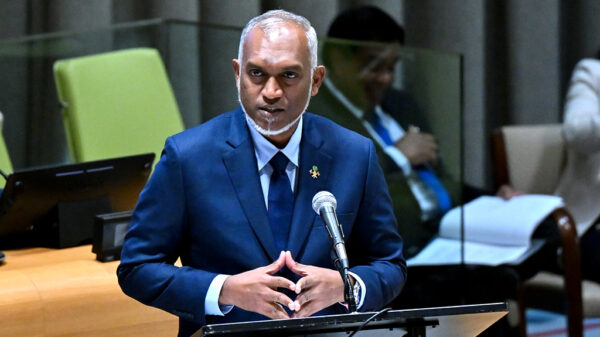




President Mohamed Muizzu has called for a stronger global focus on the oceans in diplomatic decision-making, describing an ocean-centred foreign policy as essential not only for island nations but for the international community as a whole.
The remarks were delivered during a keynote address at the German Council on Foreign Relations (DGAP) as part of his ongoing official visit to Germany.

Welcomed by DGAP leadership, including Rolf Nikel, Thomas Kleine-Brockhoff and Dr Kira Vinke, President Muizzu said that despite their vital role in climate regulation, biodiversity preservation and global food security, oceans remain underrepresented in international diplomacy.
Highlighting the Maldives’ deep connection to the sea, the President said the nation’s history, economy, culture and national security are inseparable from the ocean. He warned that climate change poses disproportionate risks to small island developing states, making marine sustainability and environmental protection matters of survival.
He also drew attention to the Maldives’ strategic position along major global trade routes in the Indian Ocean, an area witnessing growing geopolitical competition. In this context, he stressed the importance of safeguarding undersea digital infrastructure through cooperation, shared norms and respect for international law.
President Muizzu noted that small states are increasingly playing a meaningful role in shaping global standards, particularly through advocacy for ambitious climate action, enhanced marine conservation and inclusive multilateral engagement.
Concluding his address, he said that for the Maldives, an ocean-centred foreign policy is existential. At the same time, he described it as indispensable for the wider world, calling for strengthened collaboration with Germany and other like-minded partners to ensure the oceans remain spaces defined by cooperation, sustainability and shared responsibility.
During a question-and-answer session that followed the speech, President Muizzu elaborated on the Maldives’ approach to ocean governance. He said the country’s policy is grounded in strong regional partnerships, respect for territorial integrity and environmental stewardship.
He highlighted ongoing efforts to enhance national capacity to safeguard the Maldives’ Exclusive Economic Zone (EEZ) and reaffirmed the country’s commitment to global climate action.
Reflecting on nearly six decades of diplomatic relations between the Maldives and Germany, the President said there is scope to further expand cooperation, particularly in areas such as shore protection and climate resilience initiatives.



